
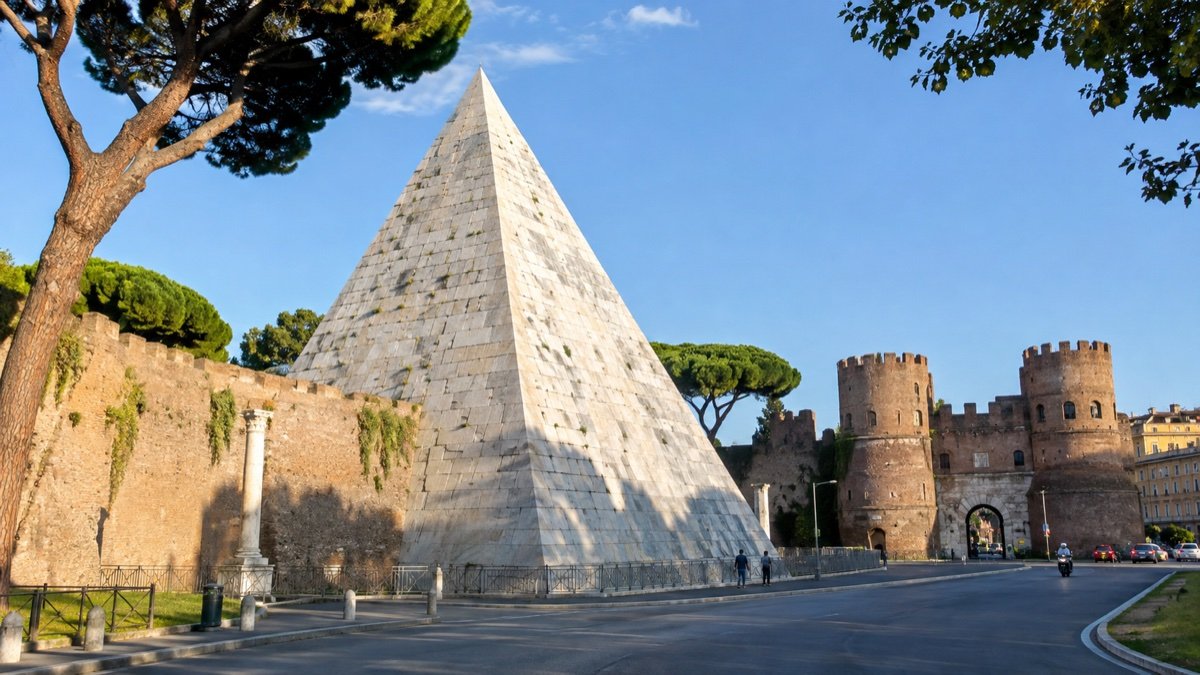
The Pyramid of Cestius is an ancient Roman tomb built for Caius Cestius between approximately 18 and 12 BC. Its white marble form rises near Piramide metro station and is one of Rome’s most surprising reminders that the ancient city absorbed ideas from across the Mediterranean.
You turn a corner in Rome expecting another church or ruin—and there it is: a pyramid. That unexpected contrast makes the monument an unforgettable stop for travelers who want to discover more than the usual landmarks.
Why is there a pyramid in Rome?
Following Rome’s conquest of Egypt, Egyptian-inspired styles became fashionable among some Romans. Caius Cestius, a Roman official, chose a pyramid as his tomb. According to Rome’s official tourism office, the monument was completed within a period specified in his will and later incorporated into the Aurelian Walls.
The pyramid is Roman in origin, even though its shape reflects a wider Mediterranean influence. Its steep profile also makes it visually distinct from the pyramids many travelers associate with Egypt.
Where is the Pyramid of Cestius?
The pyramid stands by Piazzale Ostiense, near Piramide metro station on line B and Porta San Paolo. Its position makes it a useful stop when exploring the Ostiense and Testaccio areas. You can view the exterior from public areas; use crossings and pavements carefully around the busy roads.
Can you go inside?
Interior visits are not the same as viewing the exterior and may be offered only on scheduled dates or under special arrangements. Do not assume you can enter when you arrive. Check current notices from Rome’s tourism office and the relevant heritage authority for opening dates, reservations and access conditions.
What else can you see nearby?
- Porta San Paolo: See the city gate and the historic walls around the pyramid from the surrounding area.
- Non-Catholic Cemetery: A nearby place of remembrance with notable graves and sculpture; check its visitor rules and hours.
- Ostiense: Explore a neighborhood that offers a different side of Rome’s history and contemporary life.
- Centrale Montemartini: Pair ancient sculpture with industrial heritage in this former power station museum, allowing time for travel and its opening schedule.
See the pyramid on a hidden gems tour of Rome
Our Hidden Gems & Rome Catacomb semi-private tour lists a glimpse of the Pyramid of Cestius alongside the Aventine, catacombs and Appian Way. It is a convenient option if you want several lesser-known places in one itinerary. The listing does not promise entry inside the pyramid; ask about the route and inclusions before booking. Catacomb tickets are listed separately.
Frequently asked questions
Is the pyramid in Rome Egyptian?
No. It is a Roman tomb built for Caius Cestius, inspired by the popularity of Egyptian forms in ancient Rome.
Can you see it without a ticket?
The exterior is visible from public areas. Interior admission is separate and depends on the current opening arrangements.
Which metro stop is closest?
Piramide station on metro line B is close to the monument.
Discover Rome’s unexpected side with us. Explore and book the Hidden Gems & Catacombs tour.